Choosing between a hand-worked liquid metal finish and a factory-consistent PVD colored sheet comes down to three questions: how much the surface will be touched, how much variation the design can accept, and how much of the area is flat. Here is the honest answer before the detail.
Quick answer: Specify a liquid metal finish for low-touch, curved or one-of-a-kind feature surfaces where artisanal variation is the point. Specify PVD colored stainless steel for large flat areas, high-traffic interiors, elevator cabins, and any project that needs hundreds of panels to match. For most commercial interiors, PVD is the safer default and liquid metal is the accent.
What Is a Liquid Metal Finish?
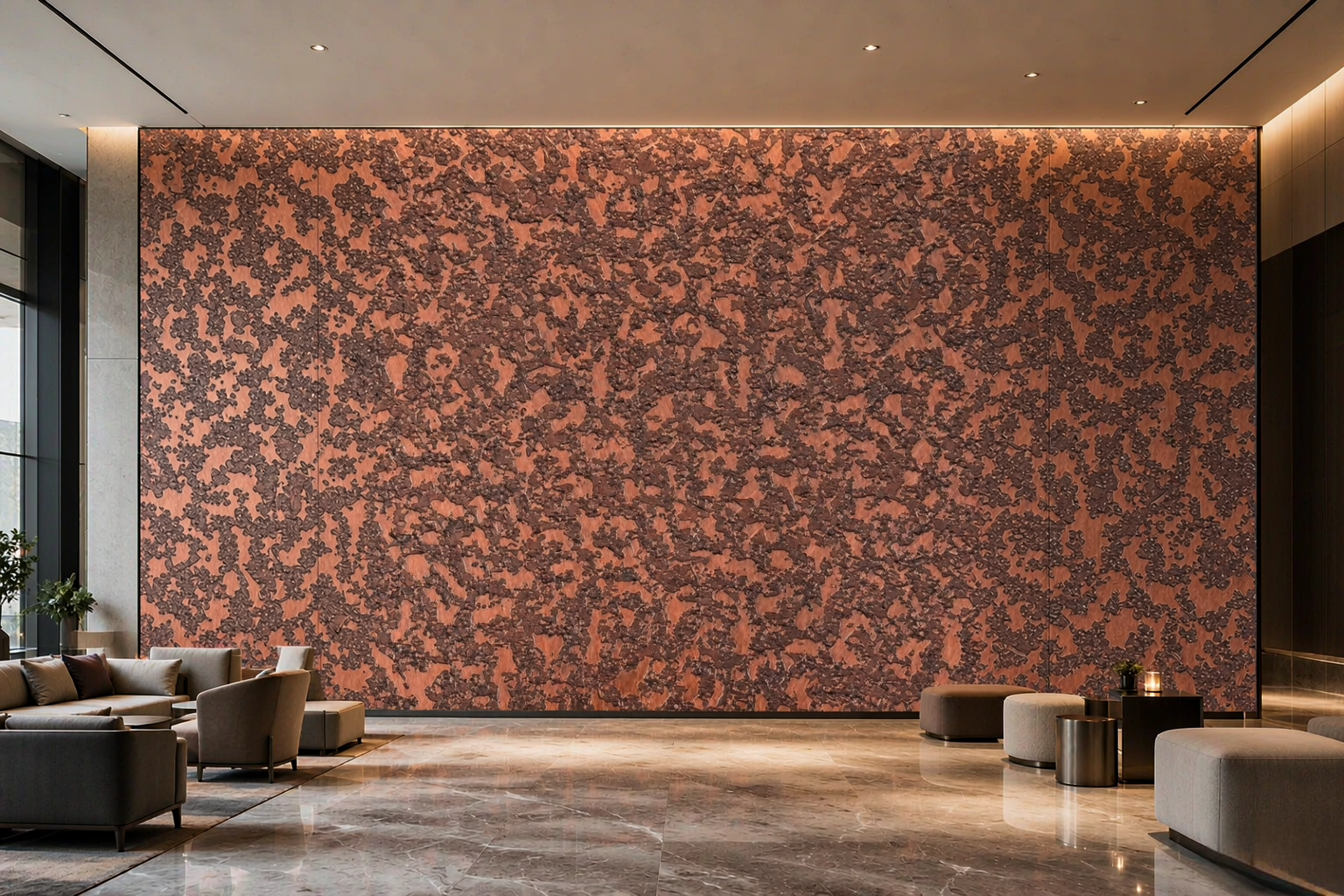
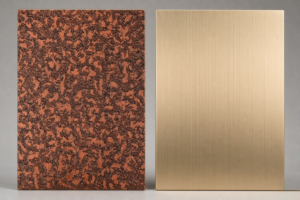
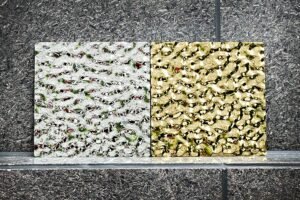
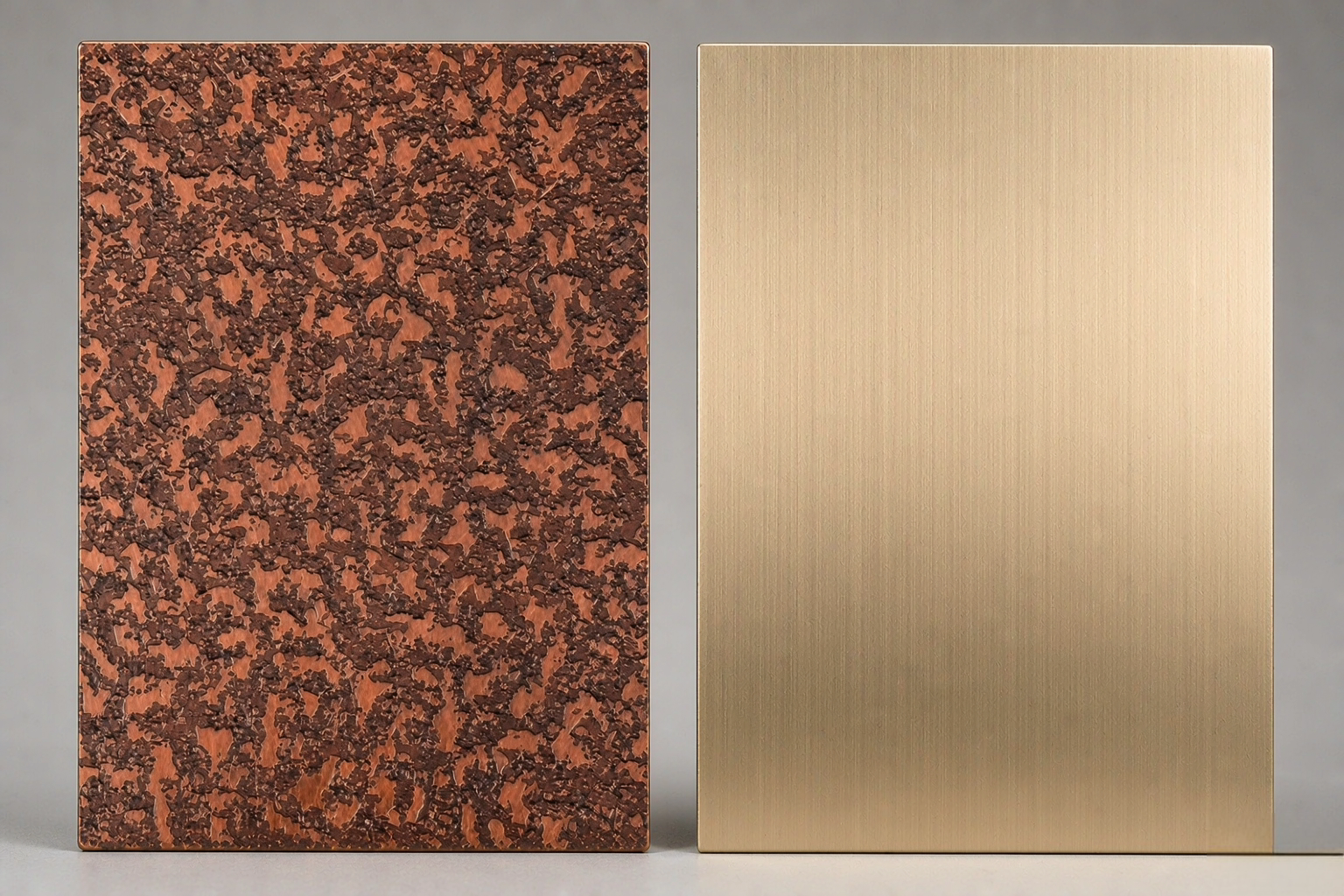
A liquid metal finish is a decorative metallic coating applied to a stainless steel base. Unlike polishing or PVD coating — both of which modify the steel surface itself — the finish is built up on top of the sheet: a metallic coating is sprayed or spattered, worked by hand while wet to create flowing, irregular relief, then sealed under a clear protective topcoat.
The result looks like molten, hand-poured metal. Because the pattern is shaped manually, no two sheets are identical. That is the reason designers specify it — and also the reason it needs careful sample approval and batch control.
Common tones include antique copper, bronze, black gold, verdigris green, rose gold and champagne. Custom tones can be matched from a physical sample.
What Is PVD Colored Stainless Steel?
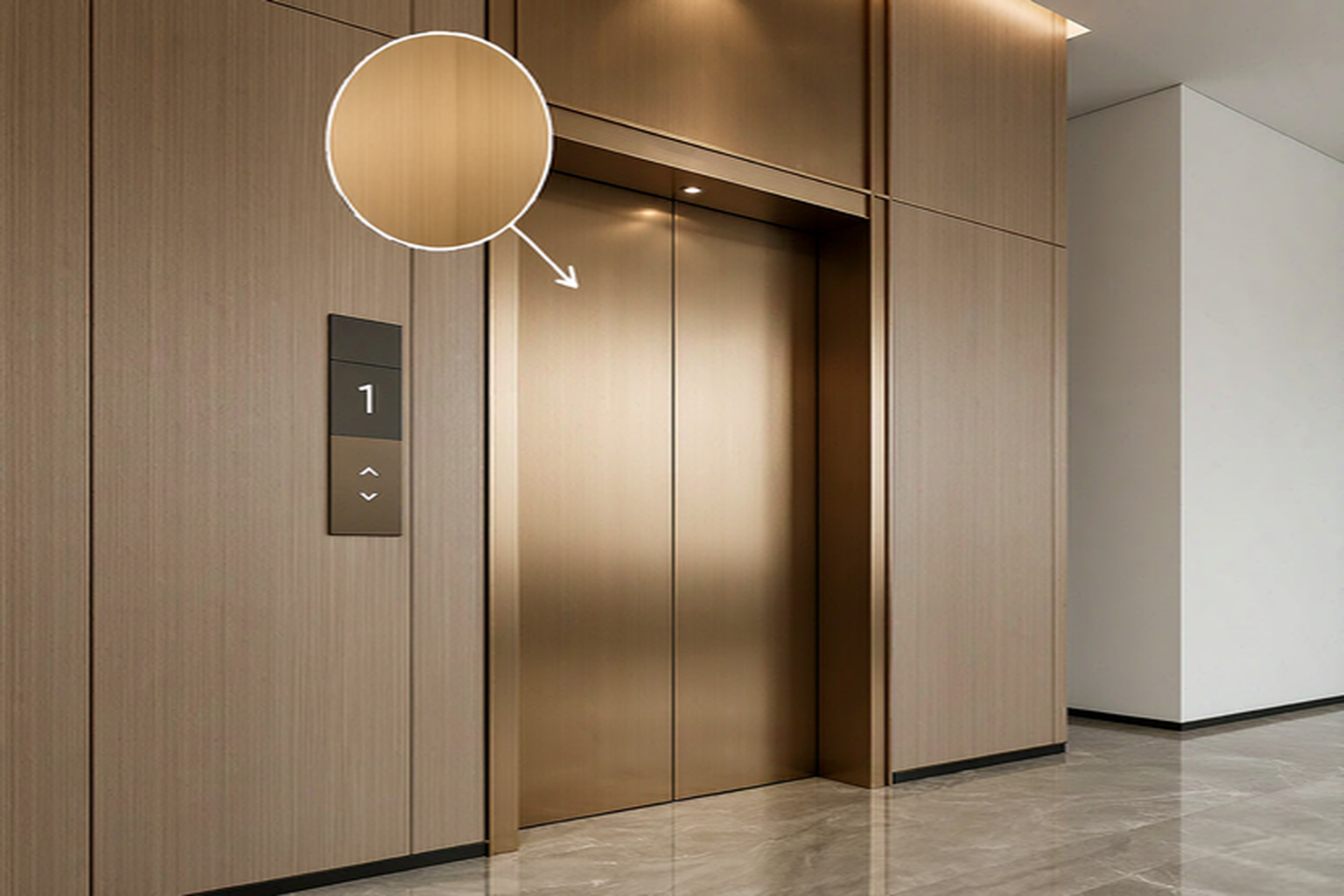
PVD (Physical Vapor Deposition) is a vacuum coating process that deposits a thin, dense metal-compound layer directly onto the stainless steel surface. Colors such as gold, rose gold, black titanium, champagne and bronze become part of the sheet rather than a surface paint.
The process is repeatable at scale. A panel produced in the third batch will read the same as one from the first — which is exactly what large wall cladding, ceilings and elevator interiors require. PVD also preserves the underlying steel’s scratch and corrosion resistance, and it can be applied over mirror, brushed, hairline or embossed bases.
Side-by-Side Comparison
| Specification point | Liquid metal finish | PVD colored stainless steel |
|---|---|---|
| How the surface is made | Hand-worked metallic coating over steel, sealed with a clear topcoat | Vacuum-deposited coating bonded to the steel surface |
| Pattern consistency | Intentional variation — each sheet is unique | Repeatable — panels match across batches |
| Typical base grade | 304 for interiors; 316 for coastal environments | 201 / 304 / 316L depending on application and budget |
| Typical thickness | 0.8–1.5 mm for wall and column panels | 0.3–3.0 mm depending on fabrication |
| Standard sheet size | 1000 / 1219 / 1500 mm wide; 2000 / 2438 / 3048 mm long | 4×8 ft (1219×2438 mm) standard; custom sizes available |
| Best environment | Interior, low-abrasion, controlled lighting | Interior and, with 316 base, exterior or coastal |
| Scratch resistance | Coating-dependent — more vulnerable to abrasion | High — the steel surface remains protective |
| Repairability | Local touch-up and re-seal possible | Damaged panels usually replaced |
| Cost at scale | Higher; labor-intensive and slower to produce | Lower per m² on large flat areas |
| Lead time | Sample approval first; batch production follows | Stock finishes ship fast; custom colors need sampling |
| Typical MOQ | Per design, based on approved sample | Low MOQ available on stock colors and patterns |
Five Questions That Decide the Specification
- What is the geometry? Curved, arched or sculpted surfaces favor liquid metal — the coating follows the shape without panel joints. Large flat planes favor PVD sheets.
- Where is the project? Coastal, exterior or high-humidity sites should use 316 stainless steel with PVD. Keep liquid metal for interiors.
- How much contact will the surface take? Elevator cabins, corridors and reception desks are high-touch — PVD resists scratches and cleans easily. Low-touch feature walls can carry a liquid metal finish.
- Does consistency matter? If 200 panels must look identical, choose PVD. If controlled variation is part of the design intent, choose liquid metal.
- What are the budget and program? Tight budget at scale favors PVD. A premium budget with a shorter on-site application window can favor liquid metal.
Where Each Finish Works Best
Liquid metal finish
- Hotel lobby feature walls and reception backdrops
- Curved columns, sculpted niches and arched openings
- Boutique retail, restaurants and private clubs
- Cabinet fronts, furniture and decorative objects
PVD colored stainless steel
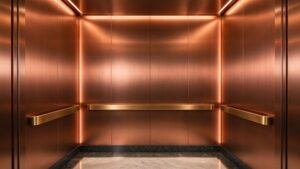
- Elevator cab interiors and door panels
- Large wall cladding and ceiling systems
- Corridors, lobbies and high-traffic public areas
- Exterior and coastal facades when specified in 316
Sourcing Checklist for Buyers Importing from China
Whichever surface you choose, the same sourcing discipline applies. Ask every supplier for:
- A physical approved sample — essential for liquid metal, since color codes alone cannot describe a hand-worked pattern.
- Base grade and thickness confirmation in writing (201 / 304 / 316L).
- Batch consistency terms — how variation is controlled and what tolerance is accepted.
- Packaging detail — PVC protective film, interleaf paper, and export-grade wooden crates.
- Lead time and MOQ split between stock finishes and custom production.
- Mill certificates and coating test reports where the project specification requires them.
Frequently Asked Questions
Is a liquid metal finish the same as PVD coating?
No. PVD is a vacuum-deposited layer bonded to the steel. A liquid metal finish is a hand-applied metallic coating built on top of the steel and sealed with a clear topcoat. One is a factory process; the other is closer to a craft finish.
Will every liquid metal panel match?
No, and they should not. Each sheet is different. Pattern scale, relief, density, color balance and overall character should stay within the approved sample range — controlled variation is the design; uncontrolled inconsistency is a defect.
Can a liquid metal finish be used outdoors?
Rarely. It is primarily an interior solution. For exterior, coastal or wet environments, specify 316 stainless steel with PVD instead — the metal itself provides corrosion resistance without relying on a coating system.
Which is cheaper: liquid metal finish or PVD colored stainless steel?
For large flat areas, PVD is considerably more economical per square meter and more predictable at volume. For small, complex or curved surfaces, a liquid metal finish can be competitive because it avoids custom panel fabrication and visible joints.
Which finish is better for elevator interiors?
PVD colored stainless steel. Elevator cabins are enclosed, high-contact spaces where scratch resistance, machine-consistent finishes and easy panel replacement matter more than seamless handcrafted coverage.
How long does each finish last?
A properly sealed liquid metal finish performs for years in low-touch interiors, with occasional re-sealing in higher-contact areas. PVD colored stainless steel lasts as long as the underlying sheet under normal interior maintenance, and can be used outdoors when specified in 316.
Can liquid metal be applied over stainless steel?
Yes. The coating can be applied to a clean, prepared stainless steel base — including 2B, brushed or sandblasted finishes — which is how the material gets both its depth and its structural strength.
What should I send a supplier for an accurate quotation?
Reference images, application, approximate dimensions, quantity, drawings and, for custom colors, a physical sample. That is the only way to judge which surface suits your wall — not the category in general.
The Bottom Line
Use PVD colored stainless steel where consistency, durability and scale matter. Use a liquid metal finish where the surface itself is the statement. Most projects need both: PVD for the large fields, liquid metal for the one wall everyone remembers.
TiDouble Metal, based in Foshan, China, supplies decorative stainless steel sheets in PVD colors, water ripple, antique copper, etched and embossed finishes for architectural and interior projects worldwide. Send your specification to TiDouble@163.com for a quotation and samples.